The guide · Seven short chapters
Read a diamond
like the trade.
Everything we'd tell you across the table, with something to play with in every chapter. Ten minutes here and no certificate will confuse you again.
01 / Cut
Cut decides
where light goes.
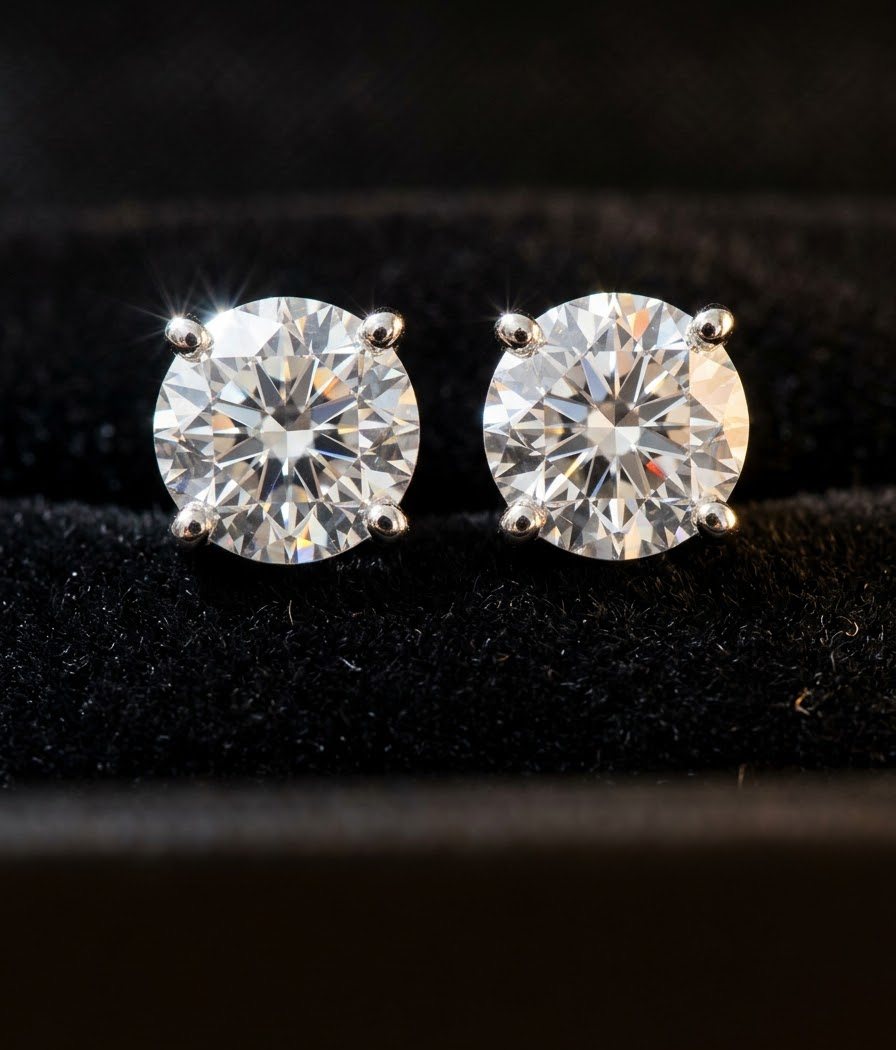
A diamond is a set of mirrors. Light enters the top, bounces off the angled facets underneath and comes back to your eye. That's brilliance. Cut the bottom too shallow or too deep and the light leaks out instead.
The rays below are traced with diamond's real refractive index (2.42). Light only bounces back when it strikes a facet at more than 24.4°; otherwise it escapes.
02 / Colour
The less colour,
the rarer.
White diamonds are graded from D (no colour at all) down to Z (light yellow). The steps are tiny; graders compare stones face down against master stones. Set in yellow gold, an H looks as white as an E.
03 / Clarity
Nature's
fingerprints.
Almost every diamond has tiny crystals or feathers inside it, formed deep underground. Clarity grades how many there are, how big, and how visible under 10x magnification. From VS2 up, most are invisible to the naked eye.
04 / Carat
Weight,
at true size.
One carat is 200 mg. Size grows slower than weight: a 2 ct round is only about 26% wider than a 1 ct. The stone below is drawn at its real diameter. Calibrate your screen in the ring-size chapter for exact scale.
05 / Shapes
Same carat,
different presence.
Shape is taste, but it changes how big a stone looks. Elongated shapes (oval, pear, marquise) look larger face up than a round of the same weight. Step cuts (emerald, asscher) trade sparkle for long flashes of light and show inclusions more.
06 / Certificates
Trust the paper,
check the stone.
A grading report is an independent lab's opinion of the four Cs, plus measurements and a plot of inclusions. Every stone we sell above 0.30 ct has one. Check that the report number matches the laser inscription on the girdle; we'll show it to you under the loupe.
07 / Ring size
Find the size
on this screen.
Calibrate once with any bank card, then lay a ring that fits on the screen and grow the circle until it touches the inside edge. No ring to hand? Wrap a strip of paper round your finger and measure it.